|
|
 |
Jeremy Gaston | Reporter
OSAGE CITY—Osage City took the first steps to a more effective
downtown last week.
Business owners and interested citizens gathered Feb. 9 in the Osage
City Depot to take an in-depth look at the Kansas Main Street program.
The program is a multifaceted approach to revitalizing the downtown
business and community atmosphere that has been utilized in dozens
of communities around the state.
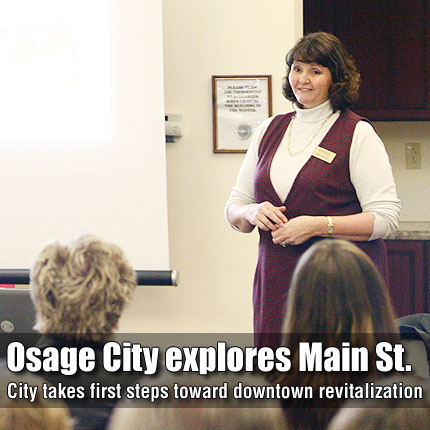
A presentation and question-and-answer session was led by Mary Helmer,
assistant state coordinator for Kansas Main Street.
“It’s about a return to local community,” Helmer
said. “What you want your downtown to be, and what’s
unique about Osage City.”
Helmer presented the four points of the Main Street program –
organization, promotion, design and economic restructuring –
while emphasizing the community involvement required to achieve
success.
“If you work, things will happen,” she said. “Communities
that understand that are the most successful.”
The program centers on volunteerism, local investment and reinvestment,
public and private partnership, broad perspective and progressive
improvements.
“It’s incremental,” Helmer said. “It’s
not going to happen next week. It’s going to take time.”
The purpose is to build a strong downtown, initially focusing on
existing business and local assets, such as the Osage City Depot
and other historic buildings. The goal is to create a central business
district which has a positive impact and reflection on both the
residents and visitors of Osage City, that will attract new business,
strengthen infrastructure, keep money in town, stabilize the tax
base and protect history.
There are currently 23 communities in the Kansas Main Street program.
In the last fiscal year, those cities logged 58,650 volunteer hours,
had 176 new or expanded businesses, added 43 upper-level apartments
and 254.5 new jobs.
Beyond the organizational help of the Main Street program, member
cities also have access to receive Incentives Without Walls grants
and loans. The loans are given in three competitive rounds, with
a maximum of $15,000 per community, per round, and are paid back
into the local fund. Like everything else in the program, all cash
stays local.
Main Street communities also receive input and evaluations from
other cities in the program.
“It’s an opportunity to learn from those who have been
there before,” Helmer said.
Last week’s presentation brought Osage City the closest it’s
come toward application and acceptance into the program, which accepts
two new communities each year, though about a dozen apply.
To apply and be accepted, the city must:
• create a separate non-profit organization.
• hire a professional, qualified program director. This could
be a part time person.
• have minimum of $30,000 initial investment by the local
community. Helmer said this fund is often divided between the city,
foundations, private investments and fundraising.
• become a member of the Kansas Downtown Development Association
(KDDA).
• make a minimum five-year commitment. “You’re
in it for the long haul,” Helmer said.
On of the first steps in the application process is to attend a
Kansas Main Street application workshop, in which City Manager Nick
Hernandez went to last month. Herneandez said the next step would
be to continue to build support, through word of mouth and additional
meetings.
“I think there’s a fairly positive response out there,”
Hernandez said. “It’s the first step in the long process,
hopefully the support will remain strong.”
Business owners and organizers agreed on bringing in program directors
from other Main Street communities in the area and of similar size.
“We’ll have another presentation, and from there we’ll
go forth with setting up a preliminary planning committee,”
Hernandez said. “We want to get some directors form other
Main Street programs come in and talk, hopefully within the next
month. Then see what direction they want to head for this year.”
Hernandez said the city did not need to make this year’s application
deadline, which is May 22. Helmer also encouraged the city to take
its time, possibly becoming a KDDA member first and applying in
2010, but staying involved in planning and learning about the Main
Street program.
“You can date us before you marry us,” Helmer said.
The meeting ended with a show of support for moving forward with
the program, as well as praise for several area cities involved
with the program, mentioning Marysville, Wamego and Ottawa.
Additional information on the Kansas Main Street program can be
found at www.kansascommerce.com/mainstreet,
www.mainstreet.org, and
www.kddadowntown.org.
|
|
|
|