|
|
 |
Wayne White
Managing Editor
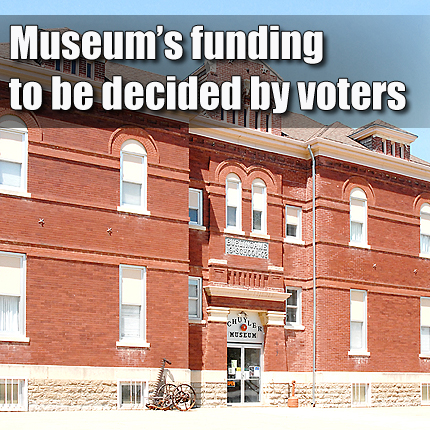
The city of Burlingame will provide utilities to Schuyler Museum
until April, at which time it will be the citizens’ decision
whether to continue funding for the almost seven-year-old museum.
Just finished with preparation of next year’s budget, the
Burlingame City Council had recently confronted financial shortfalls.
Those shortfalls were still on the minds of council members as they
heard the request for continuing a utility abatement for the museum
at last week’s council meeting.
In a council room packed with museum supporters and other citizens,
the discussion several times turned chaotic with council members
and citizens talking at the same time, requiring Burlingame Mayor
Brenda Dorr to use her gavel to restore order more than once.
The council first heard from president of the Burlingame Historical
Preservation Society (BHPS), David Prescott, who outlined the benefits
of the museum to the town, and the society’s ongoing maintenance
and upkeep of the former schoolhouse.
“Had the BHPS not been organized and acquired the Schuyler
school, there would be yet another building deteriorating and crumbling
and making an eyesore in the community,” Prescott said.
“The Kansas Department of Commerce estimates every visitor
from outside the community brings $17 into the community,”
he said. “The museum has proven its ability to draw people
to the community to visit.”
He said the museum combines with other draws that make the town
an attraction, listing the Santa Fe Trail, downtown historical buildings
lining the wide, brick main street, historical homes, and a rails-to-trails
trailhead.
Prescott noted the city first provided the utility abatement in
November 2001. A second agreement was made in 2003 for utilities
to be provided for another five years. The request at the Sept.
2 council meeting came five years to the day after the council had
approved the second abatement.
During the last six-and-a-half years, Prescott said, the museum
averaged utility usage of $502 per month, figured at retail cost.
“That’s not the actual cost the city of Burlingame incurred
for [providing utilities],” he said.
The original agreement allowed the society utilities in an amount
not to exceed $12,000 per year.
“Overall usage has always been half of the allotted amount,”
Prescott said, pointing out museum volunteers have strived to keep
utility usage to a minimum by not using air conditioning except
when necessary, and only heating and cooling part of the old building
and the nearby museum annex as needed.
Prescott asked the council to compare Schuyler Museum with other
museums in the county.
“The Osage City Railroad Museum and the Osage County Historical
Society are both supported financially by public entities’
money,” Prescott said. “Yet the Schuyler Museum, with
the least amount of financial backing of the three museums, has
grown to the largest museum offering the most public programs and
year round operation.”
Questioned by council member Vikki DeMars regarding the society’s
expenses, society members said they had over $103, 000 in expenditures
in the last seven years, with over half of that going toward upkeep
and maintenance of the building. Completed projects include brick
repair, termite control, boiler repair, and furnace replacement
in the museum annex. A recently successful fundraising effort concluded
with the repair of the museum’s roof.
Answering DeMars, Prescott said the society had held multiple fundraisers,
but “most of our backing comes from private donations.”
Currently the society has 105 dues-paying members, he said.
“Is there not any way we can help you out besides just paying
your utilities?” asked DeMars. “I’m so worried
about this town financially.”
An unidentified citizen posed a mathematics question to the council,
coming up with an answer that the museum’s utility costs amounted
to an average donation of $1 per month by each of the city’s
utility customers.
Opposition to the city funding the museum’s utilities was
also presented. The council heard from resident Kathy Kessinger,
who noted 36 percent of the city’s population had an average
social security income of $11,002 a year.
Kessinger also pointed out that Osage County, the city of Burlingame,
the school district, cemetery, and local fire district had raised
mill levies this year, putting an extra burden on low-income residents.
“Taxes went up $34 (a year),” Kessinger said. “That’s
$3 a month approximately your taxes went up. It’s sticker
shock any way you put it.”
Roberta Bailey said the council recently voted to increase the mill
levy, and an increase in utilities was figured into the budget.
“I ask how are we doing all these things?” Bailey said.
“If we don’t have the money to provide services that
people deserve, how are we going to have the money to continue doing
this? Where does it end?”
Bailey received a “yes” answer when she questioned if
the city recently cashed a certificate of deposit to pay bills.
Society member Stephanie Teeslink told the council, “Regardless
of any numbers that you’ve heard tonight, I ask that you would
consider the legacy that you leave your children, and your children
will someday be proud to say ‘my parents were a part of keeping
what we have today.’”
Following the presentation, councilman Kevin Fry offered a motion
to extend the present agreement another five years. No other council
members seconded the motion, prompting Dorr to declare the discussion
completed.
“We have a motion on the table. Is there a second? It will
die for lack of a second,” Dorr said, bringing an objection
from councilwoman Carolyn Strohm.
“I don’t think it’s fair to people who have come
and made the presentation to drag this on,” Strohm said. “If
we let this die, it’s one more death, one more nail in the
coffin.”
With the discussion continuing, Fry said he had voted against the
utility abatement twice previously.
“This is why I changed my mind, we just spent $50,000 on the
library that the city owns,” he said. “If we hadn’t
owned the library, we wouldn’t have to fix that foundation.”
“It’s a service – the museum is no better or no
worse than a swimming pool, a library and a ball diamond,”
he said. “We don’t have to worry about that with the
museum, all they’re asking us for is the utilities.”
“Then give us the title,” responded councilman Norman
Bloomquist.
“Then we would be responsible for all the repairs,”
Fry said.
“Do you want to invest in the town? That’s all it comes
down to,” said Prescott. “We’re just asking for
a minute fraction of help in support.”
“By the time that small factor is put with everything else,
it’s not so small anymore … is there another way to
work something out?” DeMars asked.
With Dorr insisting the council move on to other topics on the meeting’s
agenda, councilman Dustin Swander offered another motion.
Talking over the mayor’s gavel, Swander said, “My thoughts
are let’s put it on the ballot and let the people vote, because
they’re the ones that are paying for it.”
Strohm questioned whether the abatement would continue if the council
took no further action.
“No, the motion died,” Dorr answered.
With coaxing from Strohm, Swander clarified his motion to extend
the utility abatement until the April election, at which time citizens
would make the decision.
“We’ll have to keep paying it until it goes on the ballot,”
Swander said.
“I’ll second that motion,” Strohm said.
With the mayor asking for a vote, the motion was approved 4-1 with
Bloomquist being the sole dissenter.
Also on the April ballot will be two council seats, now held by
Fry and Swander, along with the mayor’s position. |
|
|
|